
Most conversion work assumes the form is the finish line. Shorten it, simplify it, and buyers will glide through. Here is what everyone misses: some buyers will always want to talk to a person.
If you sell online and over the phone, look at how hard your mobile site makes it to call you.
This change shipped on the ecommerce site of a national wireless carrier, led by Lubble’s founder as part of the carrier’s digital team. The client’s name is withheld for confidentiality.
The Problem Nobody Was Looking At
The carrier sold phone plans two ways: an online checkout and a telesales team. Internally, the push was for a phone-free, store-free website, with every buyer completing the purchase online. The UX was not ready to carry that load on its own.
Then we looked at where sales calls were actually coming from.
- 95% of sales calls came from desktop.
- Less than 10% of site traffic was on desktop.
Almost every visitor was holding a phone, and almost none of them were using it to call. The mobile experience was built for buyers who never need help, and plenty of real buyers do.
Even before the change, the credit check step was the single biggest source of sales calls, and roughly three in four of those calls reached an agent. Here is the call data from that step before the redesign:
| Page (before the change) | Calls | Answered by an agent | Offered calls | New connect orders |
|---|---|---|---|---|
| Credit check | 1,261 | 73% (920) | 22% (278) | 3% (39) |
| Credit check (alternate URL) | 525 | 72% (376) | 20% (107) | 4% (19) |
| Credit check, sales-agent path | 33 | 85% (28) | 12% (4) | 3% (1) |
The Hypothesis
No matter how simple the online checkout gets, some buyers want to talk to a person before they commit. Put a tappable path to a sales agent in front of mobile visitors, and more of them will call. More calls from shoppers who are already mid-purchase should mean more orders.
The Change
- Rollout: a site-wide UX change, measured period over period against the weeks before launch
- Pages: product detail pages, cart and credit check
- Devices and audiences: all
- Primary KPI: orders
Measuring orders kept the results honest. A call only counts if it closes.
What changed:
- Redesigned the mobile header to hold two buttons.
- Replaced the generic “Activate” button with a clearer, offer-led call to action.
- Added a click-to-call button that dialed the sales line directly.
- Added a “Contact Sales Agent” link for shoppers who wanted help mid-checkout.
- Built a “choose your own path” flow, so shoppers could move from ecommerce to telesales at any step, product pages included.

Call tracking connected every call back to the page it came from, so we could see which placements produced conversations and which produced orders.
The Results
The jump showed up almost immediately. Before launch, daily calls from mobile phones mostly ran between 200 and 600. After launch, they regularly topped 900 and peaked above 1,000. Landline calls barely moved.
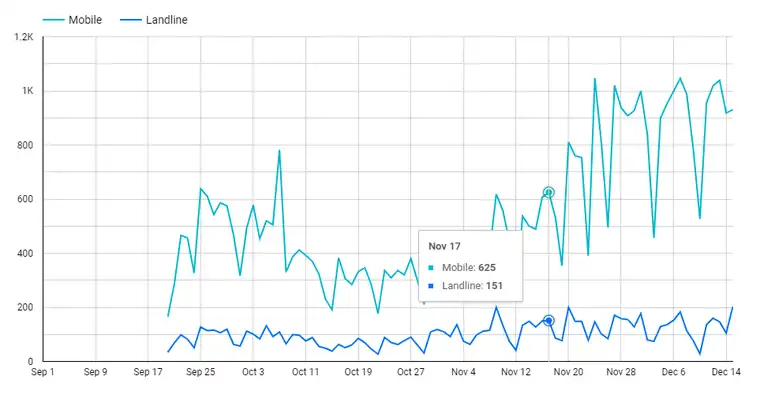
Period over period after launch:
| Metric | Mobile | Change | Landline | Change |
|---|---|---|---|---|
| Sales made by phone | 1,337 | +244.6% | 267 | +230.6% |
| Total calls | 18,734 | +94.3% | 3,107 | +19.7% |
| Offered calls | 6,121 | +87.0% | 957 | +21.1% |
| Calls not answered by an agent | 5,733 | +121.9% | 854 | +33.0% |
Landline phone sales climbed too, likely because the clearer header and agent link reached every device. Mobile carried the volume, though: 1,337 of the 1,604 phone sales came from mobile callers.
Total orders across online and phone rose 38%. That is the number that matters most, because it shows phone sales added to online orders. Buyers who would have abandoned the checkout now had another way to say yes.
What Happened Next
These results gave us the data we needed to convince the VPs to put more focus on telesales.
From there, we kept testing. Each new round measured exactly how much of the telesales lift was incremental, so every investment decision rested on real numbers.
By the following year, incremental orders from the mobile telesales program represented 11,000 lines per quarter.
What We Would Watch Next Time
Unanswered mobile calls rose 122%. Demand outran the sales floor. If you add a call button, staff the phones for it. Every unanswered call is paid traffic going to waste.
Why It Worked
Executives want every customer to buy through the digital experience. It is cheaper, it scales and it is easy to measure. But there is always a subset of buyers who want to call or walk into a store, even when the online path is as simple as it can be. A phone plan with a credit check raises questions people want a person to answer. Giving that group a fast way to reach a sales agent captured orders the site was already losing.
What This Means for Your Business
Pull two numbers from your analytics today: the share of your traffic on mobile, and the share of your calls from mobile. If those numbers look nothing alike, the same opportunity is sitting in your header.
Lubble runs UX changes and tests like this through our conversion rate optimization service, and we track every call and form back to revenue with GA4 and CRM integrations. Every engagement starts with a free audit.
FREE MARKETING CONSULT
Want results like these for your business?
A senior strategist will review your ads, search, and tracking, then send you a strategy deck. Free, with no obligation.


